

You do everything by the book. Show up at the gym consistently, drink your protein shake within the prescribed window, track your macros religiously. You’ve read the articles, followed the influencers, invested in the supplements. And yet—your muscles aren’t responding the way they should. Recovery takes longer than expected. Progress stalls. You wonder what you’re missing.
The answer, it turns out, isn’t in the protein itself. It’s in what happens after you swallow it.
What many discover the hard way is that protein is not a simple equation. You can eat all the right amounts and still come up short if you don’t understand the journey that protein takes through your body. The fitness industry focuses relentlessly on how much protein you need, but rarely addresses the more important question: How much of that protein actually reaches your muscles?
The Hidden Complexity
Here’s what they don’t tell you in the fitness magazines: Between the protein on your plate and the muscle on your frame lies a complex obstacle course. Your digestive system must break down the protein into amino acids. Your gut must absorb those acids efficiently. Your bloodstream must transport them to muscle tissue at the right moment, when your cells are actually listening.
At each stage, things can go wrong. Digestion can be sluggish. Absorption can be blocked. Timing can be off. Recent research involving over 600 participants reveals that only about 50% of dietary protein-derived amino acids appear in the circulation over a five-hour period after consumption—meaning roughly half of what you eat never makes it to your muscles. It passes through you unused, converted to urea and flushed away, a biological loss that shows up as disappointing results in the gym and the mirror.
Scientists call this bioavailability, which sounds technical but means something simple: How much of what you eat actually does what you want it to do?
For someone trying to build muscle, poor bioavailability means missing the window when muscles are most receptive to repair after a workout. For older adults facing what researchers call anabolic resistance—their muscles’ diminished response to protein signals—efficiency isn’t optional. It’s essential.
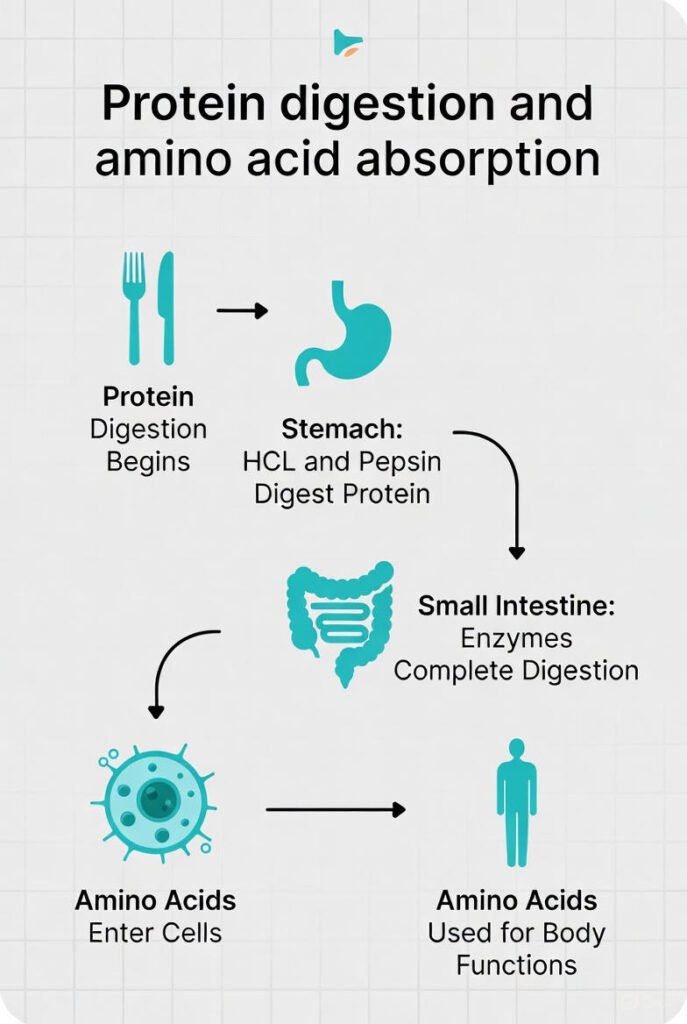
The digestive system operates as a complex network where amino acids must navigate multiple barriers. Protein digestion begins in the stomach and continues in the small intestine, where enzymes break proteins into amino acids, dipeptides, and tripeptides. These components are absorbed primarily in the jejunum through specialized transporters. But introduce certain foods at the wrong time—fiber that binds protein, tannins that interfere with absorption, calcium that competes for uptake—and you’ve created bottlenecks that prevent efficient amino acid delivery to muscle tissue.
The Protein Type Problem
Not all proteins are created equal when it comes to absorption, and the differences are more significant than most people realize.
In a comprehensive analysis examining whey, casein, and milk protein, researchers found that milk protein led to 65% of amino acids appearing in circulation, whey protein resulted in 57%, while casein produced only 45%. This isn’t a minor variance—it represents a 44% difference between the best and worst performers.
Fraction of Dietary Amino Acids Appearing in Circulation
Typically, 40–77% of ingested protein-derived amino acids appear in the bloodstream within 5 hours, depending on protein source and processing.
For casein, about 55% of amino acids are released into circulation over 5 hours 12, while milk and insect proteins show higher rates (73–77%).
Whey protein results in a greater fraction (up to 61%) compared to casein (as low as 41% for larger doses).
Roughly half to three-quarters of dietary protein-derived amino acids appear in the bloodstream within 5 hours after ingestion, with the exact proportion influenced by protein type, processing, and dose.
Hydrolyzed and free-form proteins are absorbed more rapidly and extensively than intact proteins. Age and sex have modest effects, while exercise does not significantly change amino acid appearance. These findings inform dietary strategies for optimizing protein nutrition and muscle health.
How these proteins behave in your digestive system is important. Casein forms what scientists call gastric coagula—essentially, it clumps together in your stomach, creating a slow-release effect. While this can be advantageous for overnight muscle building, it means less immediate amino acid availability. Whey, by contrast, digests rapidly, flooding your bloodstream with amino acids quickly but for a shorter duration. Milk protein, containing both whey and casein naturally, provides an intermediate response that appears most efficient overall.
Food processing matters too. Heating, hydrolysis, and aggregation can accelerate or decelerate digestion and absorption. Harsh processing may reduce amino acid bioavailability, while strategic processing—like creating protein hydrolysates—can enhance it.
The Dose and Timing Question
There’s a reason athletes obsess over post-workout shakes, and it’s not just ritual or superstition. Your muscles have a memory, and they remember when they’ve been stressed. After resistance training, they enter a heightened state of receptivity, a brief period when they’re primed to absorb amino acids and begin repair. The anabolic window, researchers call it, though recent studies suggest the window stays open longer than we once thought—not minutes, but hours.
Research shows that consuming greater protein doses increases the amount of dietary protein-derived amino acids appearing in circulation—but this doesn’t mean consuming massive amounts. There’s a ceiling effect where your body can only process so much at once, while excess gets converted to energy or waste rather than muscle.
The goal for most people is 20 to 40 grams of protein within an hour or two after training, delivering raw materials when the construction crew is on site and ready. Wait too long, and you’ve missed the moment when your body’s protein synthesis machinery is running at peak efficiency.
The same principle applies to sleep. Your body repairs itself at night, spending those quiet hours rebuilding tissue broken down during the day. A slow-digesting protein before bed—casein, which releases amino acids gradually—becomes an overnight fuel source, sustaining muscle protein synthesis while you rest.
Even meal spacing throughout the day affects results. Spread your protein intake across four or five meals, and you maintain a steady supply of amino acids. Load it all at once, and your body can only process so much, while the excess gets converted to energy or waste rather than muscle.
The Age and Sex Factors Nobody Mentions
Here’s where the absorption story becomes critical for anyone over forty: aging fundamentally alters how efficiently your body processes protein.
Studies comparing young adults (average age 22) with older adults (average age 71) reveal that older individuals show significantly slower protein digestion and amino acid absorption, with only 45% of dietary protein appearing in circulation compared to 51% in younger individuals. That’s a 12% reduction in efficiency—a loss that compounds over time and contributes directly to age-related muscle loss.
This isn’t just about slower digestion. The aging digestive system undergoes structural and functional changes. The gut’s ability to transport amino acids across the intestinal wall diminishes. First-pass metabolism—where digestive organs extract amino acids for their own use before those acids reach muscles—becomes more extensive. In essence, your gut keeps more of the protein for itself, leaving less available for muscle building.
This biological reality explains why older adults need higher protein intake to achieve the same muscle-building results as younger people. It’s not that older muscles need more protein per se—it’s that less of the consumed protein actually reaches those muscles. The recommendation for older adults to consume at least 1.2 grams of protein per kilogram of body weight isn’t arbitrary; it compensates for reduced absorption efficiency.
Modulating Factors: Age, Sex, and Exercise
Older adults show slightly reduced or delayed amino acid appearance, but the total amount over 5 hours is similar to younger adults.
Sex differences are minimal for amino acid appearance, but women may have a greater muscle protein synthesis response.
Exercise does not significantly alter the fraction of dietary amino acids appearing in circulation, though it can affect overall protein balance.
The Partnership Problem
But protein type, dose, and age tell only part of the story. What you eat with your protein changes how your body handles it.
Pair protein with carbohydrates, and something interesting happens. The carbs trigger insulin release, and insulin—whatever else we’ve learned to fear about it—is remarkably effective at shuttling amino acids into muscle cells. A protein shake with a banana isn’t just more palatable than powder in water. It’s functionally superior, a biochemical tag team working in your favor.
Vitamin C enhances the digestion of plant proteins, helping break them down more efficiently. Omega-3 fatty acids reduce inflammation and may amplify muscle protein synthesis. These aren’t supplements you need to buy separately—a piece of salmon gives you both protein and omega-3s; berries with your yogurt add vitamin C.
But there are also saboteurs, compounds that actively interfere with protein absorption. High-fiber foods, while valuable in their own right, can bind to protein in your gut and carry it out of your system before it’s absorbed. Tannins in tea and coffee do the same. Compounds called trypsin inhibitors in raw legumes can reduce protein digestibility. Excess calcium competes for absorption. Alcohol disrupts the entire process, impairing protein synthesis even when amino acids are available.
Your gut microbiota—the trillions of bacteria living in your digestive system—also plays a role, modulating protein absorption and metabolism in ways researchers are still unraveling. The relationship is reciprocal: your protein intake affects your gut bacteria composition, which in turn affects how well you absorb and utilize that protein.
The solution isn’t to avoid these interfering foods—many of them are nutritious—but to separate them from your protein meals. Have your coffee between meals. Enjoy your high-fiber cereal at breakfast, but keep your main protein intake for lunch and dinner. Cook or soak your legumes to reduce the phytates and trypsin inhibitors that inhibit absorption.
What Works
So what does this look like in practice for those of us trying to build or maintain muscle without turning nutrition into a second job?
It looks like structure with flexibility. Aim for 1.2 to 1.6 grams of protein per kilogram of body weight daily—more than the basic recommendation, but not the excessive amounts that strain kidneys and budgets. For older adults, stay at the higher end or above to compensate for reduced absorption efficiency. Spread that intake across the day, every three to five hours, to maintain steady amino acid availability.
After a workout, prioritize protein—a shake if that’s convenient, Greek yogurt if you prefer real food, a small meal with chicken or fish if you have time. Consider protein type: whey for rapid absorption when you need quick amino acid delivery, milk protein for a balanced release, casein when you want sustained availability.
Before bed, if you’re serious about muscle building, consider slow-digesting protein. Cottage cheese works. So does casein powder. Even a small serving of chicken. The overnight hours are long, and your muscles can benefit from sustained amino acid supply.
Build your meals with synergy in mind. Grilled chicken with quinoa and vegetables gives you complete protein plus the carbohydrate boost that enhances uptake. A post-workout smoothie with whey protein, banana, and spinach combines fast-digesting protein with carbs and micronutrients. Greek yogurt with berries delivers protein and vitamin C.
Choose your protein sources strategically. Eggs and lentils have excellent bioavailability when prepared properly. Dairy proteins consistently show high absorption rates. Fish provides protein plus anti-inflammatory omega-3s. Plant proteins benefit from cooking and pairing with vitamin C sources.
None of this requires expensive supplements or complicated meal plans. Overnight oats with protein powder can be prepared in minutes. Starting with just one strategic change—timing your post-workout protein and choosing the right type—is enough to begin seeing results.
The Reality of Implementation
The difference between success and frustration often isn’t effort or discipline—many people are already committed. The difference is understanding. Understanding that protein isn’t just about quantity but about delivery. That your body isn’t a simple machine where input equals output, but a complex system where timing, context, and synergy determine results.
The science here is clear, built on rigorous studies tracking exactly how protein moves through the human body. This isn’t theory or speculation. It’s measurable, replicable, proven across hundreds of participants in controlled conditions.
Someone committed to building muscle will eventually learn that their protein shake works better with a piece of fruit, consumed within an hour of their workout, without the coffee they used to drink alongside it. They’ll discover that whey gives them better post-workout results while casein serves them well before bed. Those fighting age-related muscle loss will learn that they need more protein than they thought—not because they’re eating poorly, but because their aging digestive system requires it to compensate for reduced absorption.
But knowing and doing are different things, and that gap is where most good intentions die.
The Opportunity
You have a choice in how your body handles the protein you give it. You can treat nutrition as a passive activity—eat protein, hope for results—or as an active strategy where small adjustments compound into significant outcomes.
Those adjustments don’t require perfection. You don’t need to time everything to the minute or pair every meal with scientific precision. You just need to understand the principles well enough to apply them most of the time. Choose protein types that match your goals. Time your intake around workouts and sleep. Pair proteins with foods that enhance absorption while avoiding those that interfere. If you’re older, increase your intake to compensate for reduced efficiency.
Do that consistently, and your body responds. Muscles recover faster. Strength builds more reliably. The effort you’re already making starts yielding the results you expected.
Ignore it, and you’re leaving gains on the table—not because you’re not trying hard enough, but because you’re fighting against your own biology instead of working with it. You’re losing half your protein to inefficient absorption, choosing protein types that don’t match your needs, timing your intake poorly, and pairing it with foods that block uptake.
The question is what choice you’ll make, now that you understand what the choice actually is.
Because that’s the thing about knowledge: It changes what’s possible, but only if you use it.
