

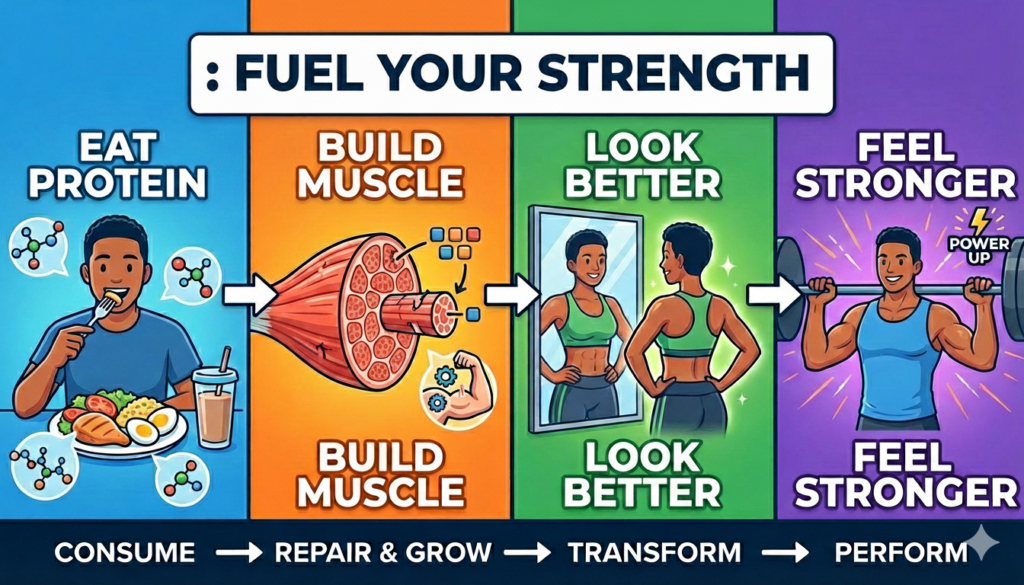
The promise of fitness culture is straightforward, almost seductive in its simplicity: Eat protein, build muscle, look better, feel stronger. Walk into any gym, scroll through social media, browse supplement aisles, and you’ll encounter this equation presented as gospel. More protein equals more muscle. It’s mathematical, logical, undeniable.
Except it isn’t.
Between the promise and the reality lies a complexity that trips up even those with the best intentions. Someone religiously downs protein shakes and eats chicken breast at every meal, only to find themselves gaining weight in all the wrong places. Another person carefully tracks their protein intake but watches their muscle mass quietly disappear despite their efforts. The disconnect isn’t a failure of willpower or dedication—it’s a misunderstanding of how the body actually works.
The truth about protein and muscle building is more nuanced than the fitness industry would have you believe. Understanding this truth means understanding why the body doesn’t simply convert protein into muscle, why training matters more than most people realize, and why age changes everything about this equation.
The Body’s Accounting System
Your body, it turns out, has no warehouse for protein. This surprises people. We know the body stores carbohydrates as glycogen, tucks fat away for future energy needs. But protein? It can’t be stockpiled. What you don’t use gets broken down—the nitrogen becomes urea, a waste product expelled through urine. The remaining calories, if you’re eating more than you burn, get converted to fat.
This fundamental fact undermines the “more is better” approach to protein consumption. When someone consumes massive amounts of protein without the corresponding activity to use it, their body can only process so much for actual muscle building. The excess doesn’t vanish harmlessly—it adds weight, just not the kind most people want.
The process of building muscle—muscle protein synthesis, in the technical language—is less like accumulation and more like construction. Imagine a work crew that can only build when you give them two things: the signal to start working, and the materials to work with. Protein provides the materials—amino acids, the building blocks. But without the signal, the crew sits idle.
That signal is resistance training. Lift weights, stress your muscles, create the stimulus that tells your body it needs to adapt, to build stronger tissue. Do that, and suddenly the protein you consume has a purpose. Skip it, and the amino acids circulate briefly before being dismantled and discarded.
The Age Factor
Age fundamentally alters how the body responds to both protein and training, yet this reality often gets buried beneath one-size-fits-all recommendations.
For younger adults, the construction crew is responsive, ready to work when called. The challenge is usually one of excess—too many calories disguised as healthy protein intake, leading to unwanted weight gain. The body’s muscle-building machinery responds readily to training stimulus, making moderate protein intake sufficient when paired with consistent resistance work.
For older adults, the problem runs deeper. It has a name: sarcopenia, the gradual loss of muscle mass that begins in middle age and accelerates if unchecked. The construction crew is still there, but they’ve become less responsive to the usual signals. They need more explicit instructions, stronger stimuli to get them working.
This is why protein recommendations increase with age—not because older bodies can store more, but because they need more to trigger the same muscle-building response. It’s also why resistance training becomes crucial, not optional, as we age. The signal must be clear enough to overcome the body’s increasing inertia.
Research bears this out across dozens of studies. Resistance training consistently increases muscle mass, strength, and physical function compared to doing nothing. Even low-volume routines help—you don’t need to become a gym devotee to see benefits. Older adults doing modest resistance work show measurable improvements in muscle size and daily function.
The key insight from meta-analyses is this: Whether you train to complete muscle failure or stop short doesn’t matter much for gains. Consistency matters more than perfection. Higher training frequency amplifies improvements. The body responds to regular stimulus.
The Protein Piece
So where does protein fit in this picture?
Think of it as the enabler, the resource that amplifies what training initiates. When you combine adequate protein intake with resistance exercise, muscle protein synthesis increases in a dose-dependent way. Studies show that around 1.5 grams per kilogram of body weight daily optimizes muscle strength gains when paired with workouts.
Certain amino acids matter more than others. Leucine, abundant in eggs and dairy, activates the mTOR pathway—a cellular switch that kicks muscle building into high gear. This is why protein quality matters, not just quantity.
Timing plays a supporting role, though not the starring one that supplement companies would have you believe. Total daily protein intake, spread reasonably across meals, drives most of the results. But strategic timing can help, especially in specific circumstances.
One compelling study found that consuming 40 grams of casein protein immediately before sleep increased overnight muscle protein synthesis by 22% in young men after resistance training. The logic is elegant: Why waste the long overnight fast when your body could be building muscle? Give it slow-digesting protein before bed, and you’re fueling recovery during hours that would otherwise be fallow.
Post-workout protein helps too, particularly for those training in a fasted state. But the research is clear: If you’re hitting your daily protein target across several meals, the precise timing becomes less critical.
What Actually Works
The foundation is practical and evidence-based: 1.2 to 1.6 grams of protein per kilogram of body weight daily for those actively building muscle. Older adults fighting sarcopenia should aim for at least 1.2 grams per kilogram. Spread this across four to five meals, about 20 to 40 grams per meal, to maintain steady muscle protein synthesis.
But here’s the critical insight that gets lost in fitness marketing: Protein intake must match your goals and activity level, not exceed them dramatically just because more seems safer.
Consuming massive amounts without the training to use it means adding calories your body will store as fat, not muscle.
Equally important: Protein alone won’t build or preserve muscle. The resistance training is non-negotiable. It’s the signal your body needs to actually use the protein you consume. Without that signal, even perfectly timed, high-quality protein consumption becomes largely irrelevant to muscle building.
The plate itself can be simple. Half vegetables for fiber and satiety. A quarter protein-rich foods. A quarter complex carbohydrates for sustained energy. No exotic foods required—lean poultry, fatty fish, lentils, quinoa, eggs, Greek yogurt, nuts. Foods you can find in any grocery store, many of them inexpensive.
Practical swaps make adherence easier. Oatmeal with Greek yogurt and nuts instead of sugary cereal. Grilled tofu or beans instead of processed deli meat. Frozen edamame or canned tuna when fresh options feel too expensive or time-consuming.
The Hard Part
None of this is mysterious. The science is solid, the recommendations straightforward. So why do so many people struggle?
Because knowing and doing are different things. Because our food culture pushes excess and convenience over balance and intention. Because the fitness industry profits from making simple things seem complicated, from suggesting that without the right supplements or perfect timing, your efforts won’t matter.
But they do matter. Resistance training works. Adequate protein works. Together, they work better than either alone, and the improvements are measurable: increased muscle mass, greater strength, better physical function, reduced risk of sarcopenia.
Success means recognizing that more isn’t always better—that precision in protein intake, matched to actual training demands, delivers results without excess weight gain. It means understanding that preservation of muscle requires active effort, that the aging body needs more deliberate stimulus than younger bodies, but responds beautifully when you provide it.
What Comes Next
Studies confirm what common sense suggests: This combination—sensible protein intake plus regular resistance training—delivers real results across all ages. It builds muscle in the young, preserves it in the old, improves daily function, enhances energy and focus.
The alternative is drift. Continued weight gain despite gym time, frustration mounting. Or the slow fade of muscle and strength that makes ordinary tasks harder, independence more tenuous.
Thousands have figured this out through trial and error. The wisdom is there in the research, in the meta-analyses that show what works and what doesn’t. You don’t need to discover it yourself through years of mistakes.
You can start modestly. Track one protein-rich meal daily. Add ten to fifteen minutes of basic resistance work—push-ups, squats, resistance bands, whatever fits your current ability. Do this for a week and notice how you feel. Stronger, probably. More energetic, certainly.
The body wants to respond. It’s designed to adapt, to build, to maintain. You just have to give it the right signals and the right materials in the right proportions.
The question is what you’ll do, now that you understand what actually drives muscle gain and maintenance.
Because here’s the thing about muscle: It’s not cosmetic, though it certainly affects appearance. It’s functional. It’s the difference between capability and limitation, between independence and dependence, between feeling strong in the world and feeling fragile.
That seems worth getting right.
