

Have you ever stood in the quiet of your kitchen at dawn, the world still asleep outside, and reached for that leftover slice of birthday cake? The first bite is pure bliss—a rush of sweetness that lights up your morning like fireworks on the Fourth.
But then, an hour later, as you’re slogging through emails or chasing the kids out the door, the fog descends: a weary slump, a gnawing hunger that wasn’t there before, as if your body has betrayed you in some quiet, personal way.
I’ve been there, more times than I’d care to admit, and it always leaves me wondering about the hidden dramas unfolding inside us, the ones we can’t see but surely feel.
This isn’t just a quirk of indulgence; it’s a window into a deeper truth about how we nourish ourselves in this hurried age. Not all foods whisper the same promises to our blood. Some shout, spiking our sugars like a sudden storm, while others hum steadily, like an old friend keeping pace beside you on a long walk.
Glycemic Index (GI) vs Glycemic Load (GL)
That’s where the Glycemic Index comes in a simple, elegant measure that demystifies the chaos, helping us reclaim a bit of grace in our daily choices. It’s not about rigid rules or scolding lectures; it’s about understanding the soul of what we eat, so we can live with more steadiness, more vitality.
Let me walk you through it, as I’ve come to see it over years of trial and quiet reflection.
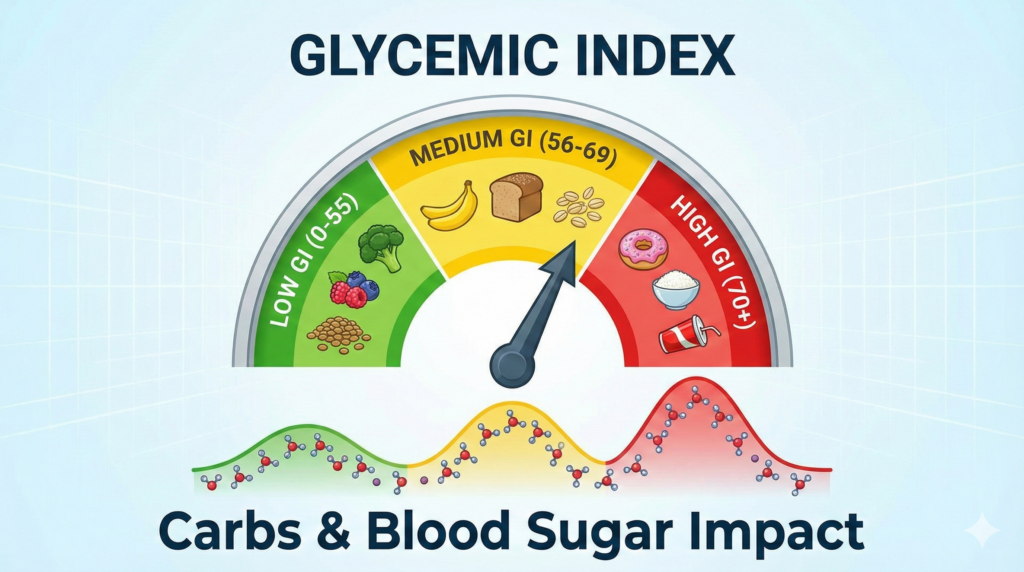
Picture the Glycemic Index as a compass in the wilderness of our modern pantry. It’s a scale from 0 to 100, pegged against pure glucose at the top, that tells us how swiftly a food sends sugar coursing through our veins.
Low numbers—55 or below—signal a gentle rise, like the sun easing over the horizon. Medium ones, from 56 to 69, offer a balanced lift, steady as a heartbeat. And the highs, 70 and up? They’re the tempests: quick, fierce surges that can leave you adrift in the aftermath.
I’ve learned this the hard way, through those mornings that start with promise and end in regret.
A bowl of cornflakes (GI around 81) pours energy like a flash flood—overwhelming, then gone, leaving parched earth behind. But switch to steel-cut oats (a solid low-GI choice), and it’s different: a slow burn, sustaining you like the enduring warmth of a wood fire on a winter night.
The body responds in kind. With high-GI foods, insulin rushes in like an overzealous guard, hauling away the excess sugar but often overshooting, plunging you into that familiar crash.
Low-GI options? They coax a milder response, preserving your inner equilibrium, letting you move through the day with a quiet dignity intact.
Yet, as with so many things in life, the index alone doesn’t capture the full story—it’s like judging a book by its cover without considering the weight of its pages.
Enter the Glycemic Load, a wiser companion that marries the food’s GI with the actual heft of carbs in a serving. It’s a formula born of practicality: GL equals the GI multiplied by the grams of carbs, divided by 100.
Take watermelon, that summertime delight with a high GI of 76. At first glance, it seems a villain, ready to sabotage your steadiness. But slice into reality—a modest portion holds just a whisper of carbs, say 5 grams—and the math reveals a low GL of about 3.8. It’s harmless, even benevolent, a reminder that context matters, that we shouldn’t rush to condemn the innocent.
This isn’t mere trivia for the health-obsessed; it’s tied to the very character of our well-being, the moral fiber of how we treat our bodies in an era of abundance and shortcuts. High-GI habits, repeated like a bad habit, wear on us over time.
They strain the pancreas, dull our sensitivity to insulin, and invite shadows like type 2 diabetes—studies whisper that every 10-point climb in dietary GI hikes the risk by 27%, a statistic that lands like a quiet warning from history.
The heart suffers too, burdened by elevated cholesterol, those silent thieves of vitality. And weight? The crashes trigger false hungers, a cycle of overreach that erodes our resolve.
But low-GI choices? They build resilience, fostering stable sugars that echo the steadfastness of our better selves. They enhance satiety, that blessed sense of enough, helping us resist the siren call of excess. I’ve seen it in my own life: swapping white bread (GI 71) for sprouted grain feels like choosing integrity over convenience, leading to clearer days and a lighter spirit.
Research bears this out, linking lower-glycemic paths to guarded hearts and minds unclouded by metabolic fog.
So how do we weave this into the fabric of our lives, without turning meals into battlegrounds?
It’s simpler than it seems—small acts of grace, like trading cornflakes for oat bran, or instant rice for quinoa, that wild, ancient grain with its earthy whisper.
Pair a higher-GI bite with protein or fiber—think pasta softened by the company of greens and grilled fish—and you temper its edge, slowing the rush like a wise mediator in a heated debate.
Cook with care: al dente over mushy, whole over processed, as if honoring the food’s original form.
And always, lean toward the unadorned gifts of the earth—legumes, nuts, vegetables—that carry low GIs as naturally as leaves carry dew.
In the end, the Glycemic Index and Load aren’t chains to bind us, but lanterns to guide us back to a more harmonious way of being. They remind us of a time when food was closer to its roots, less manipulated, more in tune with our rhythms.
We live in an age of plenty, but also of quiet losses—civility at the table, perhaps, or the simple joy of sustained energy. By heeding these measures, we honor our bodies’ quiet pleas, choosing paths that lead not to crashes, but to the steady glow of health. It’s a personal revolution, one bite at a time, calling us to our better angels.
